
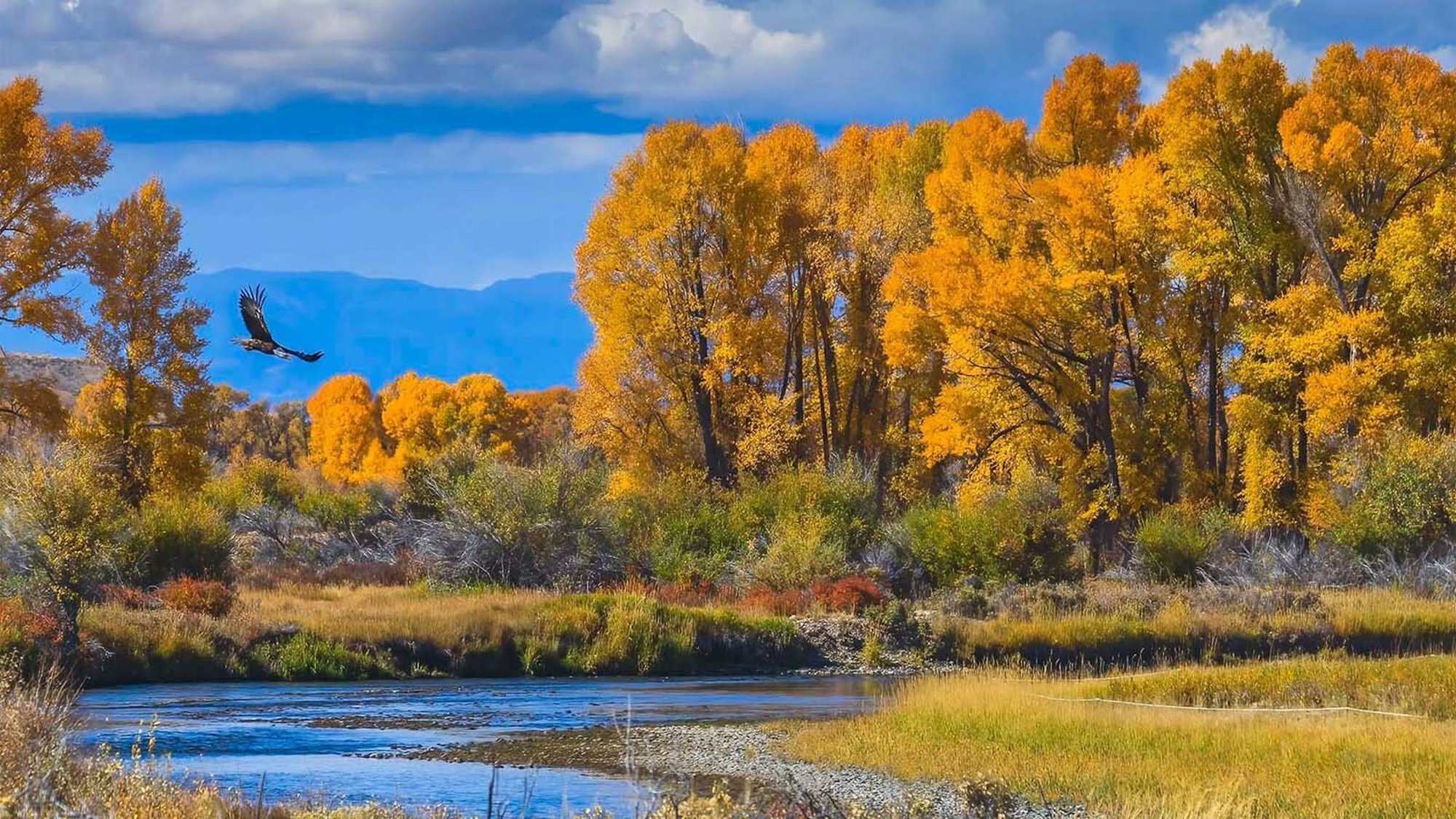
Wyoming in Fall: Where the Mountains Turn Gold
Aspens in the high country, cottonwoods along the rivers, and why the best fall drives in Wyoming start where the interstate leaves off.
Get Palmelle in your Google results.
One tap. Google shows our reporting higher when you search.
In Wyoming, autumn does not arrive as a blanket of color. It comes in flashes. A stand of aspens lights up beneath a dark ridge. Cottonwoods go gold along a river that otherwise runs through dry country. A high road bends into the mountains, and suddenly the windshield seems full of yellow. The effect is less like a New England postcard than a revelation—brief, brilliant, and easy to miss if you are driving too fast. For a few weeks each year, Wyoming residents become devoted students of elevation, weather, and roadside timing. They know that color begins in the high country, moves downhill as temperatures fall, and can disappear overnight after a hard wind. The best days are rarely announced in advance. You hear about them from a friend, notice the aspens outside town, or simply look up and realize the season has begun. Wyoming's fall color typically develops from mid-September into early October, with higher routes—including the Snowy Range, the Bighorns, and the Absarokas—turning first.
The Road to Yellowstone
The Buffalo Bill Cody Scenic Byway is one of the state's essential fall drives. The roughly 52-mile route runs west from Cody toward Yellowstone National Park, following the North Fork of the Shoshone River through steep canyon walls, open country, and dense pockets of color.
Ednor Therriault, a Montana author and veteran of Western road trips, once took the route for a final Yellowstone visit before winter and arrived hours later than planned. He kept stopping. Each overlook appeared to be the view of the day, only to be replaced a few miles later by something even more striking.
He remembered the foliage as so bright that the yellow trees seemed to match the double yellow line on the highway. "The trees start to look like they're on fire," he said, "they're so blazingly bright."
That is Wyoming's particular version of leaf-peeping. You do not necessarily head into a forest. You follow a river, pass through a canyon, or cross a high basin, and the color appears where water and elevation have made room for it.
The Bighorns in Gold
The Bighorn Mountains offer one of the state's most reliable autumn displays. U.S. Highway 16, sometimes called the Cloud Peak Skyway, runs from Buffalo through the Bighorn National Forest and across Powder River Pass before dropping through Ten Sleep Canyon. In fall, its aspens and cottonwoods turn the slopes bright gold against darker evergreen forest and the open faces of the mountains.
The drive can be taken from Buffalo or Ten Sleep, though beginning in Buffalo gives the trip a pleasing sense of escalation. The road rises steadily out of the plains, then enters a world of timber, rock, creeks, and high meadows. At the crest, the landscape opens toward the Cloud Peak Wilderness. On the western descent, Ten Sleep Canyon adds its own drama: limestone walls, sharp curves, and autumn color gathered in the lower draws.
For those who want the long version, the Bighorn Scenic Byway between Sheridan and Greybull offers another route across the range. Wyoming's roads often feel less like connectors between destinations than destinations themselves. In fall, that is especially true.
Jackson's Quiet Season
Grand Teton National Park is best known for summer crowds and winter skiing nearby, but early fall may be its most forgiving season. The air sharpens. The traffic eases. Cottonwoods, aspens, and willows color the Snake River corridor while the Tetons remain what they always are: too large to be fully absorbed by the eye.
Oxbow Bend is one of the classic stops. The Snake River curves beneath Mount Moran, and in autumn the water often carries reflections of yellow cottonwoods and aspens. Schwabacher Landing offers a quieter version of the same idea, with water, beaver ponds, and the Tetons rising behind them. Along U.S. 89/191/287, the views are frequently enough to make a traveler forget about reaching the next pullout.
Jackson Hole can still be busy in early fall, especially on warm weekends. But it is also easier to inhabit at a slower pace than it is in July. A person can make a morning of one overlook, take a short riverbank walk, eat lunch in town, and be entirely satisfied.
The Wind River Country
Central Wyoming does not always appear in the national imagination as fall-color country. It should.
The drive through Wind River Canyon, between Shoshoni and Thermopolis, is one of the state's most dramatic. The road follows the river through narrow rock walls, with the Owl Creek Mountains visible in the distance. Autumn color here does not create a continuous forest canopy; it punctuates the geology. Yellow trees trace the watercourse through a landscape of cliffs, exposed rock, and open basin.
Near Lander, the season has a different texture. Aspens turn in the foothills and mountain canyons, while cottonwoods brighten the town itself. The route into Sinks Canyon State Park follows the Popo Agie River toward the Wind River Range, offering color close enough to town for an unhurried afternoon drive. In the right week, Lander's streets, parks, and nearby canyon roads make it possible to follow autumn from the higher country down into town.
Pinedale, farther west, offers another quiet base. The drive north toward Green River Lakes moves into the Wind River Mountains, where high peaks, water, and yellow foliage make a useful antidote to any remaining attachment to a schedule. The town's CCC Ponds and Pinedale Pathway offer a more level, accessible way to see cottonwoods reflected in still water.
Want more of this?
Mark Palmelle a preferred source and it shows up when you search Google.
The Southern Aspens
In southern Wyoming, the Snowy Range Scenic Byway from Centennial to Saratoga climbs into the Medicine Bow-Routt National Forest, where aspen, willow, and cottonwood combine with high meadows and long mountain views. The route is one of the state's clearest arguments for taking a day that has nothing else planned.
Farther south and west, the Battle Pass Scenic Byway includes Aspen Alley, a well-known grove of aspens near the Sierra Madre Range. It is the sort of place that seems almost too perfect until you see it: a corridor of pale trunks and gold leaves, bright enough to make even the most skeptical traveler pull over.
These high routes come with the usual Wyoming warning. Weather is not a background condition. It is an active participant. A blue-sky morning can become rain, wind, sleet, or snow by afternoon. Road conditions change quickly, particularly at elevation. The best preparation is simple: leave more time than you think you need, carry warm layers, and do not build a day around arriving somewhere at a particular hour.
What the Interstate Misses
Interstates are useful, but they tend to flatten the state into a series of exits.
The better fall drives often begin where the interstate leaves off: Highway 87 from Casper toward Glenrock along the Platte River; Wyoming 251 over Casper Mountain toward Beartrap Meadow; Highway 14 through the Bighorns; Highway 110 approaching Devils Tower; the Flaming Gorge–Green River Basin route through southwestern Wyoming. These roads reveal how Wyoming holds color: in river bottoms, shaded canyons, mountain folds, and towns with more trees than the surrounding range suggests possible.
The trick is to follow the water. In a state that can look spare from a distance, rivers create their own narrow climates. Cottonwoods and willows gather there. Their color can turn an otherwise severe stretch of country unexpectedly soft.
And after rain, there is one more place to look. Therriault likes photographing foliage reflected in shallow pools beside the highway, especially where water collects near rumble strips. The image is small, temporary, and easily passed at 70 miles an hour. That is why it works.
Traveling at the Right Pace
Autumn road trips have a way of exposing the difference between motion and travel.
It is tempting to make a list: Beartooth Highway, Buffalo Bill Cody Scenic Byway, Grand Teton, Wind River Canyon, the Bighorns, Snowy Range. But Wyoming resists that approach. The season is too changeable, the distances too great, and the best moments too dependent on weather and light.
A better plan is to choose one region, book a comfortable place to stay, and leave the day open. Stop when something catches your attention. Drive a little less than you intended. Turn around if the weather turns. Spend longer at a pullout than seems reasonable.
For older travelers—and for anyone who has outgrown the idea that a good vacation requires constant forward movement—that kind of flexibility is not a compromise. It is the point.
Palmelle, an advocacy service for older adults, works from a similar premise: independence is not measured by refusing support or forcing life to remain exactly as it was. It is measured by whether a person can keep doing what matters safely and on their own terms. Palmelle helps families assess whether a home can be adapted for safer living and navigate care decisions with access to real facility-inspection information rather than marketing alone.
A fall drive through Wyoming is not a test. It is an invitation to notice what you would otherwise pass. The aspens will turn. The cottonwoods will flare along the rivers. The first snow will come eventually.
For a little while, though, the whole state seems to have caught the light.
Sources


More from Life & Community → · Back to Perch · Browse all stories
More of this, in your Google results.
Takes one tap, and it applies everywhere you search — not just this page.